
A Board-Defensible Forecast Is Not a Better-Looking Deck
Most teams treat board reporting as a presentation exercise. That is the wrong frame. A board-defensible forecast is an operating package that defines the number, explains how it moved, and makes the risks visible before the quarter closes. If the deck is clean but the assumptions underneath it change every month, the board still has reason to distrust it.
That is why defensibility starts before design. It starts with whether Finance, RevOps, and GTM are using the same definitions for pipeline, commit, renewals, expansion, and timing. If those definitions drift by audience, the board is not seeing a forecast. It is seeing a summary of unresolved internal disagreements.
Define the Number Before You Defend It
The first question a rigorous board member is asking is not "is the headline number high enough?" It is "what exactly is included?" A defensible board package answers that upfront.
- Period: monthly, quarterly, or annual forecast window.
- Revenue basis: bookings, billings, collected cash, ARR, or recognized revenue.
- Scope: new business only, renewals only, or a blended company forecast.
- Ownership: who submitted the number, who reviewed it, and when it was frozen for the board.
If that definition box is missing, the room ends up debating language instead of business risk. The board should not have to reverse-engineer the metric from the slide title.
Show the Variance Bridge, Not Just the Latest Forecast
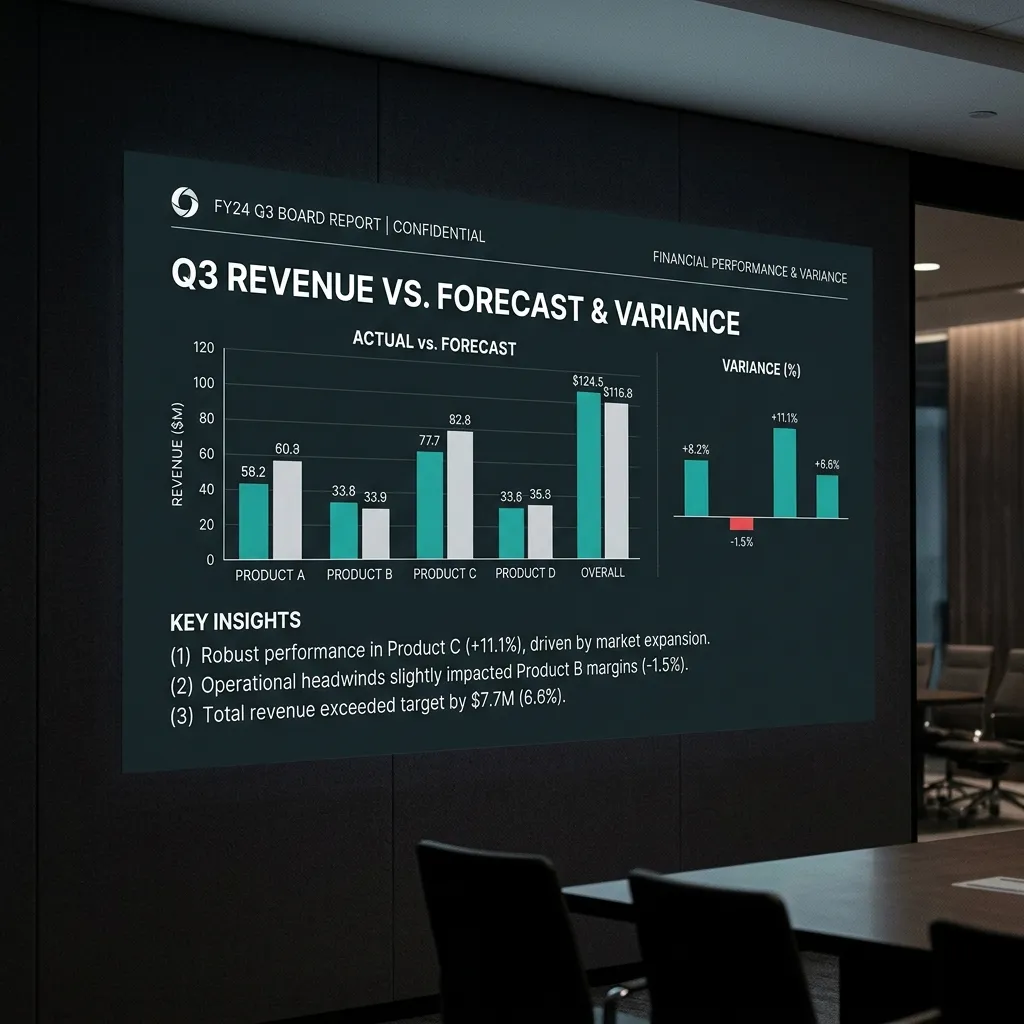
A board-defensible forecast should show movement between forecast versions, not just the latest point estimate. Otherwise leadership can always say the current number is right while quietly ignoring how far it moved from the prior submission. The variance bridge narrative is the framework that makes this movement legible to the board.
A practical bridge usually includes:
- Starting forecast: the number shown at the last board or weekly executive review.
- Movement drivers: slipped deals, delayed billing starts, renewals now at risk, contraction, upside expansion, pricing change.
- Current forecast: the latest view after those changes.
- Confidence call: which elements are evidence-backed versus still management judgment.
That bridge does two things. It gives the board a usable audit trail, and it forces the leadership team to explain whether forecast movement is coming from selling performance, operating delay, or definition drift.
Separate New Business, Renewals, and Timing Risk
Many board decks hide risk by blending everything into one top-line number. That is convenient and not very informative. New business risk, renewal risk, and timing risk behave differently and should be shown separately.
- New business: pipeline quality, stage evidence, close-date hygiene, conversion assumptions.
- Renewals: retained base, at-risk base, known contraction, expected expansion.
- Timing risk: signed but not billed, billed but not collected, implementation dependencies, approval delays.
Once those categories are separated, the board can ask a much better question: which operating system is under stress right now? Without that separation, every miss gets blamed on market conditions or sales execution even when the actual problem sits in billing timing or retention visibility.
What Evidence the Board Actually Trusts
Boards do not need infinite detail. They need evidence that the number is governed. In practice, that means a small set of proof artifacts behind the headline forecast:
- Submission cadence: a documented weekly or monthly forecast rhythm.
- Version history: visible changes between submissions.
- Defined categories: commit, best case, renewals, and timing exposure defined once and used consistently.
- Observed exceptions: the deals, renewals, or billing items already outside normal thresholds.
The point is not to remove judgment. The point is to make judgment visible where it exists and stop presenting it as settled fact.
Free Model
What is your forecast variance actually costing you?
Run the numbers: model your quarterly revenue at risk, the cost of inaction, and how fast the fix pays back, with stage-specific benchmarks for Series A–C.
Run the ROI Model →Why This Is a Forecast-Integrity Problem
A board-defensible forecast is not a separate executive-art skill. It is the reporting expression of the same controls that govern forecast accuracy week to week. If stage definitions are loose, if renewal risk enters too late, or if billing timing is not reconciled, the board package will simply magnify those weaknesses.
This is where MxM Revenue Engineering's sequence matters. The Scorecard identifies which part of the number is currently unsupported. The Controls Install puts the review cadence, definitions, and exception handling into the operating rhythm. Governance keeps those rules stable so the board package does not become a new negotiation every quarter. That is what makes a forecast defensible: not certainty, but evidence, consistency, and visible ownership.